The summer I turned 18, I visited my dad, and he took the opportunity to teach me to drive. He was teaching me to turn the car without hitting the curb, but I could not do it reliably. After being jolted as the tire hit the curb yet another time, he erupted in frustration: “What’s wrong with you? I knew girls would be bad at driving! You’re indeed bad at this! I’ve told you not to hit the curb and not to hit the curb and not to hit the curb, why are you still doing it?!”
I’d known for a long time that my dad wanted a boy: I was born under China’s One Child Policy, and it was customary for a child to take on their father’s last name. A girl, once married off, would be considered as property of her husband’s clan, giving birth to grandchildren with her husband’s last name. “Only boys can pass down the family name,” he would often lament to me. He made it extremely clear that he wanted a son — he even told me how he would name his hypothetical son — but he ended up with me.
—
In 2024 I was in San Francisco visiting friends. My friend’s roommate offered to take me on his Waymo ride to work. Sitting in the back seat, watching the steering wheel turning itself, stopping at stop signs, yielding to pedestrians, merging into traffic, I was amazed. More than amazed. I had tears in my eyes, because someone had persevered enough on this problem after I’d left, and they solved it.
Six years prior, I interned at Uber ATG, Uber’s self-driving car division. I spent weeks tweaking parameters and running experiments, teaching cars to anticipate what would happen next on the road. I did not, at that point, have a full driver’s license.
Today, I’m a mediocre driver. Getting better at driving feels like a catch-22: to become safer, I have to spend time being more dangerous. I just never accumulated that kind of practice because I lived near public transit. A good driver would have good mental knowledge of the roads, have some mental map of where things are, mentally alert to notice what’s going on around the car, and have a good reaction time to take actions. Driving takes up a lot of mental effort, and the inherent limitation of how human attention degrades makes driving risky: In the United States, car crashes are the leading cause of preventable death for people aged 5 to 22, and the second most common cause for ages 23 to 67.
—
What is good driving, fundamentally? When I sit at the wheel, I need to be spatially aware of my car’s surroundings. I need to have my attention on the road, the mirrors, the cars around me, both distributed and sustained. I need to be alert enough to react fast to traffic. I need to know what to do if something unexpected happens: if I slip on ice, if someone jaywalks, if I get pulled over, if the brake fails… Human attention, though, is inherently fallible, not to mention how our attention can degrade further under stress or get hijacked by emotion.
Driving demands a lot from the driver, and consequently there are many people who cannot drive at all, even if they wanted to. Children under legal driving age, elders, people with disability… are denied driving — and in places with no good alternative transit options, mobility — through no fault of their own.
A self-driving system breaks down the task a human driver does into roughly five stages: perception, mapping, prediction, planning and control. Using a combination of hardware and software, it does better than human can possibly do in every stage. In the perception stage, the system uses camera, LiDAR and radar to see everything around the car, covering 360 degrees in a way that’s not possible for humans; In the mapping stage, the system maintains a precise model of its distance from other objects, more accurately than humans; In the prediction stage, the system models other actors on the road, and predicts where they’d likely to go next, faster than humans; In the planning stage, the car calculates a path of movement that would avoid colliding into other objects’ predicted paths, thinking simultaneously in a way that humans cannot; finally, in the control stage, the car acts on the planned move.
Hans Rosling, in his TED talk “The Magic Washing Machine,” told the story about how purchasing a washing machine transformed his mother’s life. His mother told him, “now Hans, we have loaded the laundry. The machine will make the work. And now we can go to the library.” When a machine could do the labour, his mother got her time and attention back, and she chose to use that precious time to read to him, to teach herself English, to think.
In the same way that a washing machine does not get tired of washing, a self-driving car’s attention does not fatigue. What used to be distracted human drivers can finally pay full attention to that phone call or text message.
—
Growing up, I was told by both my teachers and parents, despite that I did well in school, that would soon change: I did well in math and science only because the boys in my class were not trying. Once I got to high school and the boys got serious, I was told, I would never be able to catch up, because I was a girl and girls weren’t meant for math or science. When it was time for me to apply to university, I picked math, and eventually a computer science minor too —partly out of love, partly out of pragmatism, partly out of defiance. I told my parents that I didn’t need them to pay for school, I’d figure out how to pay for school myself so I could study whatever I wanted.
Lucky me. From university onwards, I met many amazing friends, many of them boys, who not only had zero doubt about my ability but actively encouraged me to try challenging things. I also had many people offering to let me practice driving while they sat on the passenger seat. I’d driven on the freeways of Texas, through the forests of Pennsylvania, along the streets in New York City. The self-driving internship paid well; I saved up the money to pay back my student loans.
—
I eventually came to understand my dad’s rage: his daughter had moved to a country where he didn’t live, spoke a language he didn’t know, entered a society he couldn’t navigate. He was trying his best to make sure I would be safe, but he was lost in preparing me for a world he did not fully understand.
—
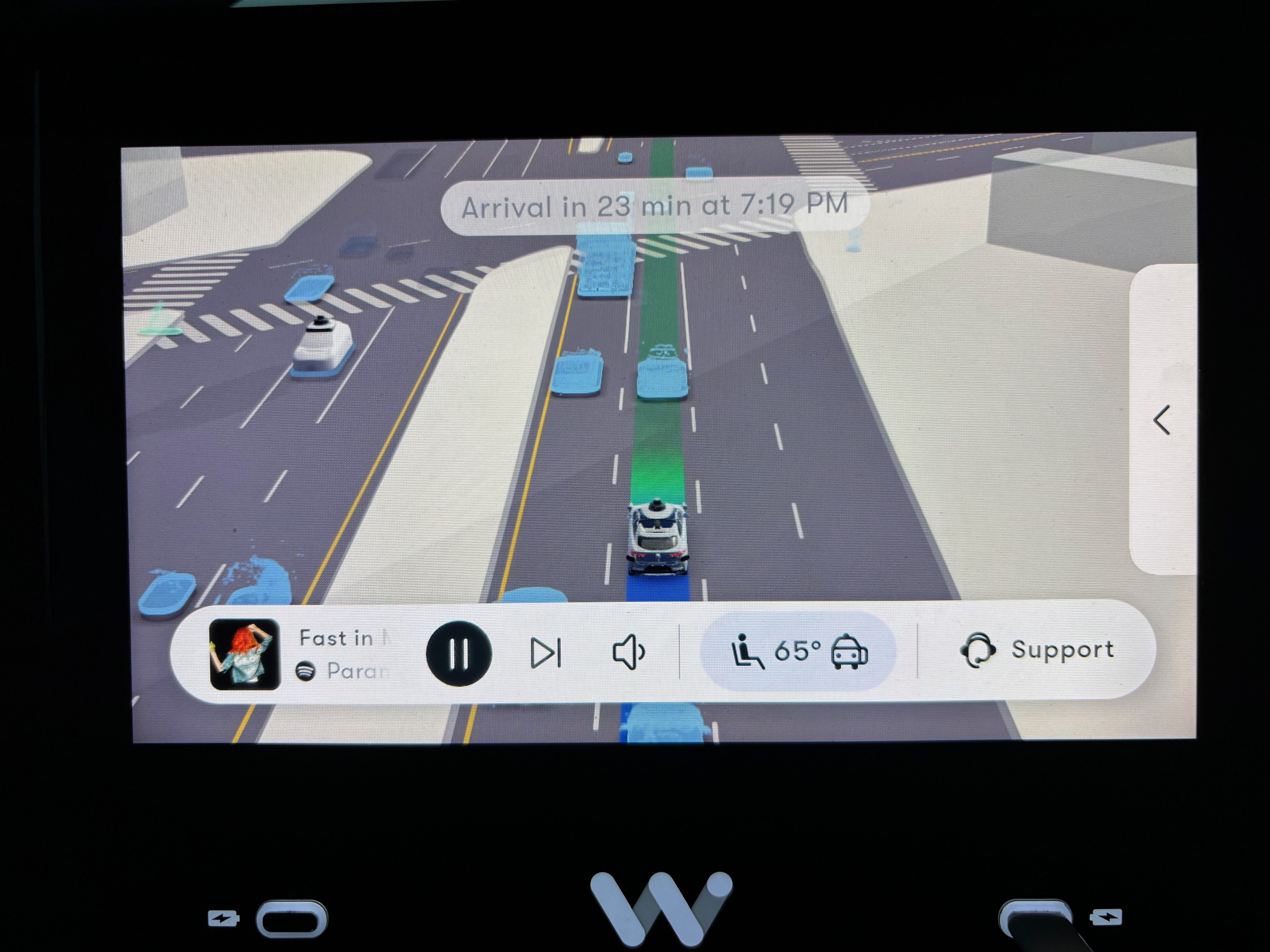
On a recent trip to Los Angeles I took many Waymo trips. I watched the city through the car window: red taco tents, green palm leaves, blue sky, orange sunsets. The car sped through the streets of LA smoothly, more smoothly than if I were the driver. I connected my Spotify to the Waymo software, and Paramore came up:
So I’ll cry just a little, then I’ll dry my eyes ‘Cause I’m not a little girl no more
Some of us have to grow up sometimes And so, if I have to, I’m gonna leave you behind
I danced a little to the music, and thought about the many people who had enough faith in me to sit in the passenger seat when I drove their cars, people who let me borrow their car for a drive on my own when I finally got my full license, people who encouraged me when math and CS got really hard, people who hired me and mentored me, people who taught me when I made mistakes. I thought about my former coworkers at Uber ATG and the many more colleagues in the self-driving field, how much time, patience and hard work they had put in to make this dream come true. Then I remembered that, in the industry, the term for self-driving was “autonomy.”
I teared up a little bit. Thank you for this piece.